

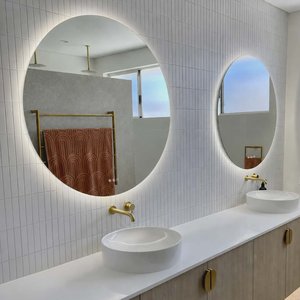
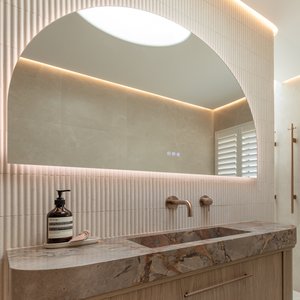
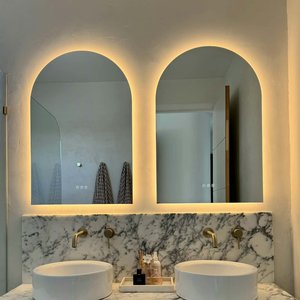
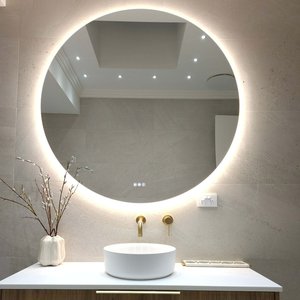
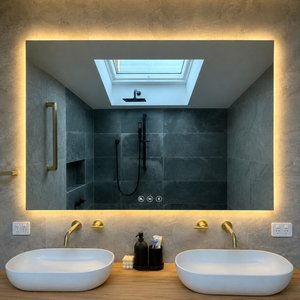
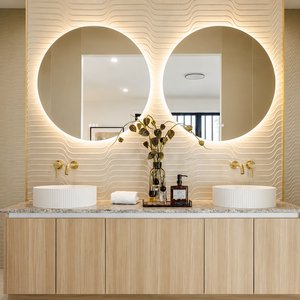
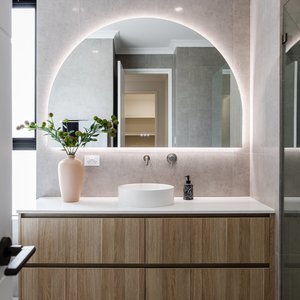
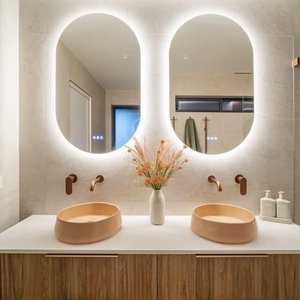


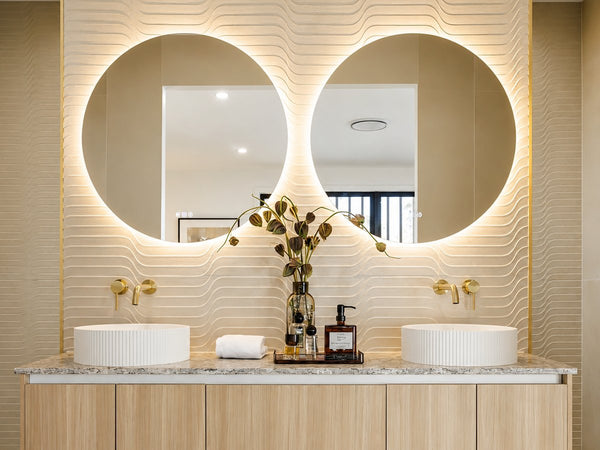
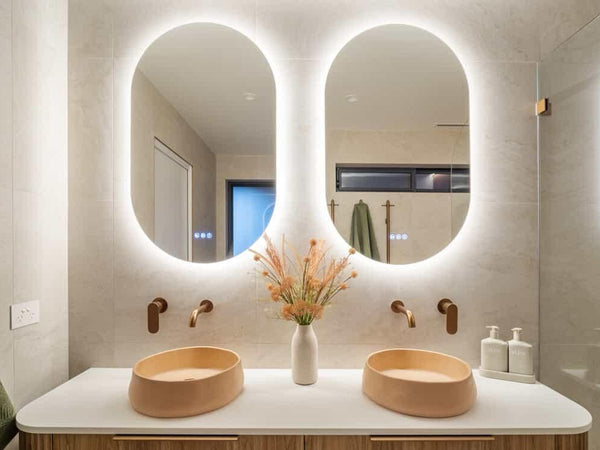
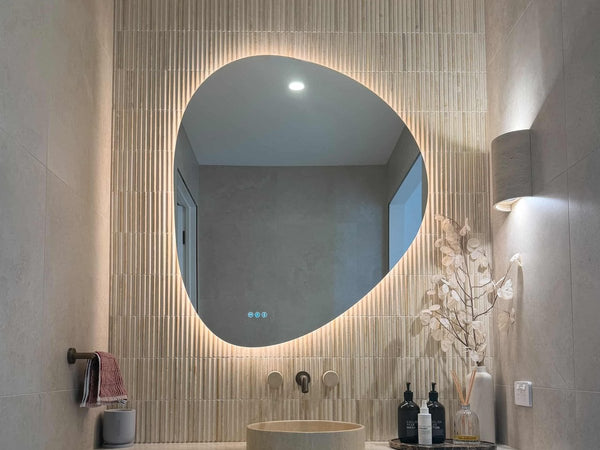
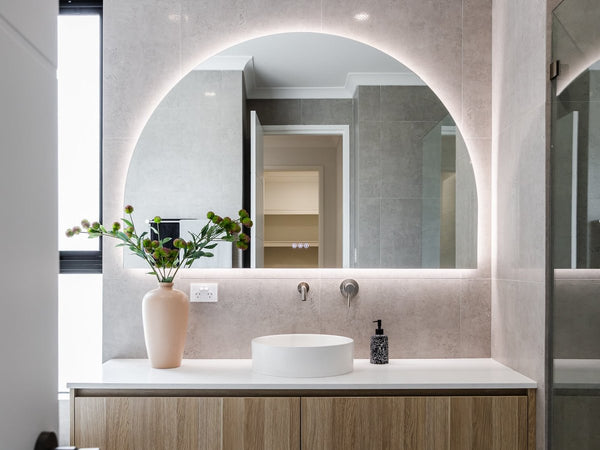
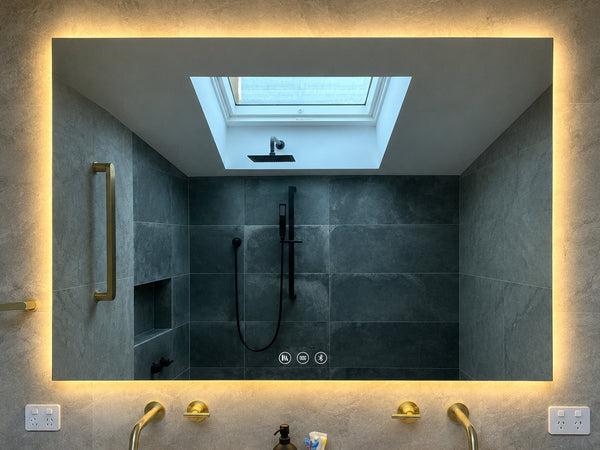
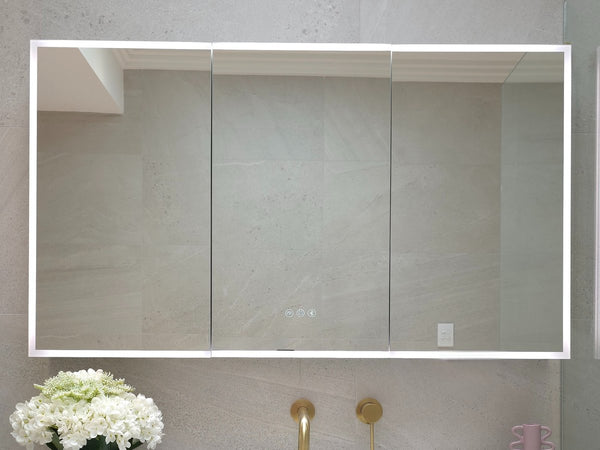
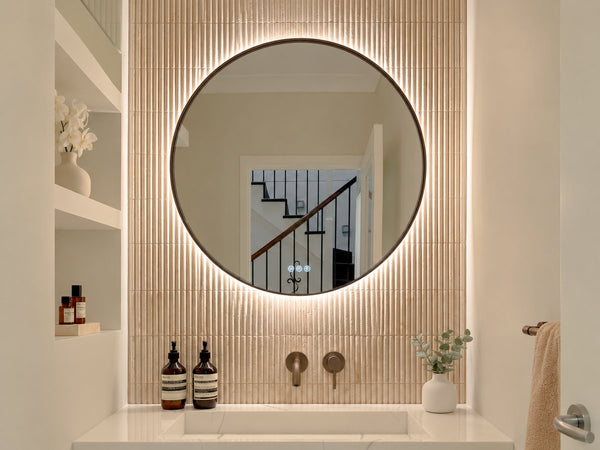
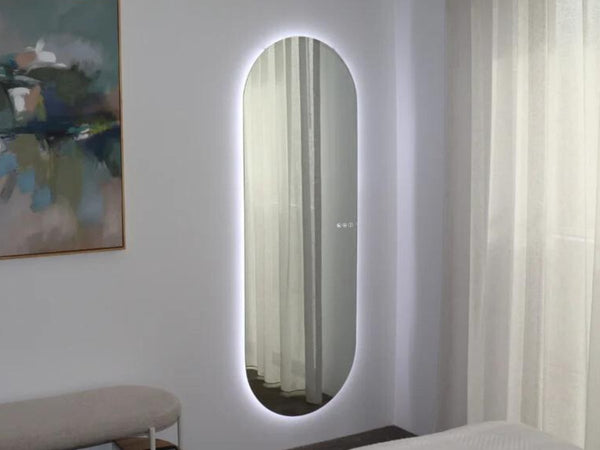

For most bathrooms, yes, if you’re happy to pay a licensed electrician to wire it in. You get even light at face height, a demister for after the shower, and one fitting instead of a mirror and a light. The downsides are the hardwiring, the higher price, and LEDs you can’t replace on their own.
We sell LED mirrors, so take this with that in mind. We’ve tried to be straight about the downsides too, because a mirror that needs an electrician isn’t the right buy for every bathroom.
Updated 20 October 2026 · Written by Ella James, InVogue Mirrors & Bathware
Why Trust InVogue Mirrors & Bathware? InVogue is an Australian retailer trusted in over 20,000 homes, specialising in LED bathroom mirrors and mirror cabinets. The recommendations in this guide come from bathroom design principles — proportion, balance and light — rather than passing trends.
The Pros: What an LED Mirror Does Well
The light is where you need it. A ceiling light usually sits behind you, so your face is in your own shadow. An LED mirror lights you from the front. Ours change between three colour temperatures, from 2700 K warm white to 6500 K cool white, and they dim. They also remember the colour and brightness you last used.

- A demister. An anti-fog pad behind the glass keeps it clear after a shower. On our three-button mirrors it has its own button and switches itself off after an hour; on our Ambient models it comes on with the light. How to clean an LED mirror and stop it fogging explains both.
- Bluetooth speakers on the three-button models. The Ambient models don’t have them.
- Made for a bathroom. Every one of our LED mirrors and mirror cabinets is rated IP44, and the glass is 5 mm copper-free mirror.
- 50,000-hour LEDs. That’s the figure on every one of our mirrors.
- One fitting on the wall instead of a mirror plus a wall light.
The Downsides of LED Mirrors
Most of the downsides come from the same thing: it’s an electrical fitting, not just glass. Here is each one, and what it means in practice.
Swipe the table sideways to see every column →
| Downside | What it means | How we handle it |
|---|---|---|
| It has to be hardwired | Our wall mirrors and cabinets run on 220–240 V with no plug. A licensed electrician connects them. | Plan the wiring point behind the mirror. In a renovation, that’s before the wall is sheeted and tiled. |
| It costs more | The mirror costs more than plain glass, and the licensed electrician’s visit is on top. | One fitting can replace a mirror and a wall light. |
| You can’t swap a bulb | The LEDs are built in. | Our mirrors carry a 2-year warranty that covers the lighting and electrics. If one fails in that time, the remedy is a new mirror. |
| It must go into the wall frame | It can’t hang on plasterboard alone. | Brackets go into studs, noggins or masonry. Two people to lift and hang. |
| Sizes come in steps | You may not find one exactly as wide as your old mirror. | Take the nearest size no wider than your vanity, or one down if space is tight. |
| The demister has a timer | On three-button models it switches off after an hour. | That’s normal. Press the button again if you need it longer. |
Our warranty terms are on the mirror and cabinet warranty page.
Are LED Bathroom Mirrors Battery Operated?
Our wall mirrors and mirror cabinets aren’t. They’re hardwired, with no plug and no battery, and an electrician connects them. The only rechargeable mirrors we sell are make-up mirrors:
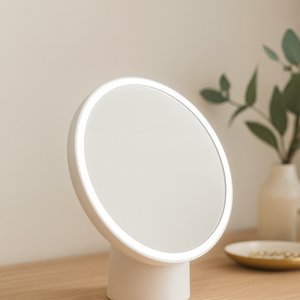
- The Oslo: a Ø140 mm round mirror with 3x magnification. It sits on its charging stand, or on the front of the mirror you already have, held by a steel plate fixed behind the glass.
- The Sicily: a flip-open compact with a standard side and a 7x side. Its light runs from 3000 K to 6500 K.
Both charge by USB-C in about 2 hours and need no drilling or wiring. They’re for close-up make-up, not for lighting the room.

How Long Do LED Mirrors Last?
The LEDs in our mirrors are rated at 50,000 hours. The mirror and its electrics are covered by our warranty for 2 years from the date of purchase. What shortens the life of any bathroom mirror is damp: run the exhaust fan during and after a shower, and clean the glass with a damp cloth rather than sprays.
LED Mirror vs a Plain Mirror and a Light
Swipe the table sideways to see every column →
| LED mirror (ours) | Plain mirror | |
|---|---|---|
| Light at your face | Built in, 2700–6500 K, dimmable | From a ceiling or wall light |
| Fog after a shower | Demister clears it | Fogs |
| Power | Hardwired by an electrician | None |
| Fixing | Brackets into studs, noggins or masonry | Clips or adhesive |
| Warranty | 2 years, lighting and electrics included | Depends on the maker |
When It’s Worth It, and When It Isn’t
It’s worth it when you’re renovating, or the vanity is badly lit. In a renovation the wiring point goes in at rough-in, so the extra cost is small. And if your vanity light sits behind you, a lit mirror fixes the shadows on your face.
It’s harder to justify when there’s no easy way to get power behind the mirror, or you only want a brighter spot for make-up. In that case a rechargeable Oslo on your existing mirror does the close-up job without an electrician.
Which One to Choose
Two decisions first. One is the controls: separate buttons for the light, demister and Bluetooth (our three-button models), or one button that does it all (Ambient). The other is size. We generally recommend the largest size that’s no wider than your vanity. When in doubt, size up, if the space allows it; if a side wall, tiles or the door make it tight, go one size down. The Check it fits your vanity tool on every mirror page draws it to scale. Browse by shape: round, arch or rectangle, or see every LED mirror.
If you want storage as well, an LED mirror cabinet has the same lighting and demister, plus a power point and shelves inside.
Frequently Asked Questions
Are LED mirrors worth it?
For most bathrooms, yes. You get light at face height, a demister and one fitting instead of two. The trade-offs are the cost and that an electrician has to wire it in.
What are the downsides of LED mirrors?
They need hardwiring by an electrician, they cost more than plain glass, the LEDs are built in so you can’t change a bulb, and they must be fixed into the wall frame. Ours have a 2-year warranty covering the lighting and electrics.
Are LED bathroom mirrors battery operated?
Our wall mirrors and cabinets aren’t: they’re hardwired. The only rechargeable mirrors we sell are the Oslo and Sicily make-up mirrors, which charge by USB-C.
Do LED bathroom mirrors need an outlet?
Ours don’t plug in. They’re hardwired, 220–240 V, with a cable that an electrician connects to a wiring point behind the mirror.
Do LED mirror lights burn out?
The LEDs in our mirrors are rated at 50,000 hours, and the lighting is covered by our 2-year warranty. If it fails in that time, the remedy is a new mirror.
Are LED mirrors good for doing makeup?
Yes. The light is in front of your face, and you can switch between warm and cool white to match where you’ll be. For close work, our Oslo (3x) and Sicily (7x) make-up mirrors add magnification.
Do you need an electrician to install a LED mirror?
Yes. Our LED mirrors are hardwired and must be installed by an electrician. See Do LED mirrors need an electrician?
Designer's Cheat Sheet
Designer's Cheat Sheet
- ✔ Worth it → most bathrooms, especially in a renovation
- ✔ Power → hardwired by an electrician, no plug
- ✔ Light → 2700–6500 K, dimmable, remembers your setting
- ✔ Fog → built-in demister
- ✔ LEDs → 50,000 hours; 2-year warranty
- ✔ No wiring possible → Oslo or Sicily make-up mirror
Where To Next?
- Fitting one: How to Install an LED Mirror
- The wiring: Do LED Mirrors Need an Electrician?
- Keeping it clear: How to Clean an LED Bathroom Mirror
- The size: What Size Mirror for Your Vanity?
- Storage too: How to Install a Mirror Cabinet
Need help? Ask us with a photo.
Send a photo of your mirror, cabinet or plans and we’ll help, or call 1300 221 495.

