


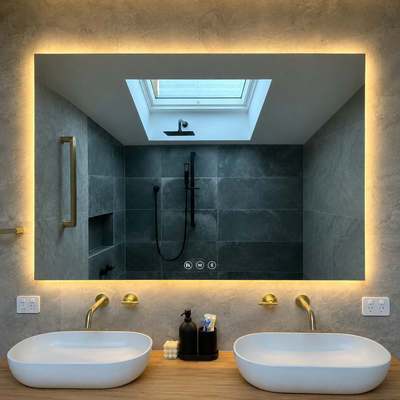
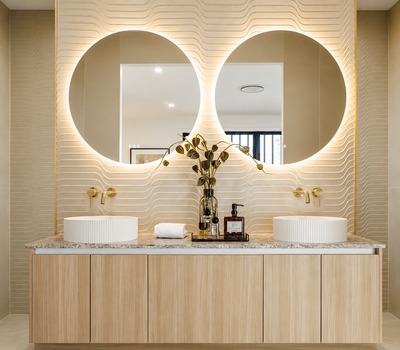
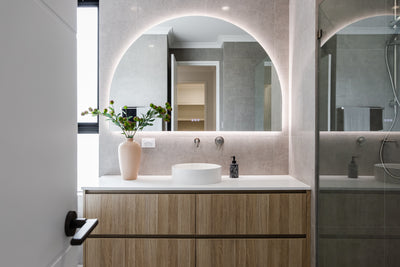
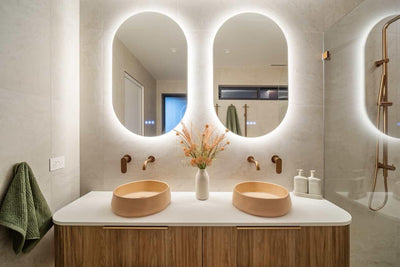




Most vanity mirrors that look wrong are the wrong width, not the wrong style. Too narrow and it floats on the wall like an afterthought. Too wide and it hangs past the benchtop, crowds the tap and makes the whole vanity look undersized.
This guide gives you one rule that works for every shape, a size chart from 600 to 1800 mm built from the sizes we actually make, and a walk-through of the Check it fits your vanity tool on our mirror and cabinet pages, which applies the same rule to your exact vanity.
Updated 13 October 2026 · Written by Ella James, InVogue Mirrors & Bathware
Why Trust InVogue Mirrors & Bathware? InVogue is an Australian retailer trusted in over 20,000 homes, specialising in LED bathroom mirrors and mirror cabinets. The recommendations in this guide come from bathroom design principles — proportion, balance and light — rather than passing trends.
Quick Answer
Go as wide as your vanity allows, up to its full width but never wider. If you'd like a little wall showing either side, choose one size down. The rule is the same for round (measured across the diameter), arch, oval, rectangle and organic shapes, and for mirror cabinets.
- 600 mm vanity: a 600 mm mirror, such as the Amalfi Ø600 round or the Positano 600 × 900 arch. One size down: oval (Riviera 450 mm) or arch (Positano Cabinet 500 mm).
- 900 mm vanity: a 900 × 700 mm rectangle such as the Florence or Venice. One size down: the Amalfi at 800 mm.
- 1200 mm vanity: a 1200 × 800 mm Florence, Venice or Santander, or the Amalfi Ø1200. One size down: the Amalfi Ø1000 or a 900 × 700 mm rectangle.
- Height: leave 100–200 mm between the top of the tap or splashback and the bottom of the mirror, never less than 100 mm.
- Not sure? Type your vanity width into Check it fits your vanity on any mirror or cabinet page.

In this guide
- Mirror size chart by vanity width
- How to use the fit check
- How to measure your vanity
- Why full width, and never wider
- Does shape change the size?
- Mirror cabinets: width, doors and depth
- Height, once the width is right
- Double vanities
- Common sizing mistakes
- Expert designer recommendations
- Frequently asked questions
- Designer's cheat sheet
Mirror Size Chart by Vanity Width
Find your vanity width in the first column. The next two columns list the largest real sizes in our range that fit without passing the vanity: that's the best fit. The last column is one size down, for anyone who'd like a little wall showing either side.
| Vanity width | Best fit: mirrors | Best fit: cabinets | One size down (a little wall either side) |
|---|---|---|---|
|
600 mm powder room |
Amalfi Ø600 round; Positano 600 × 900 arch; Riviera 600 × 1000 oval | Positano Cabinet 500 × 900 arch | Riviera 450 × 900 oval; Riviera Cabinet 450 |
|
750 mm ensuite |
Amalfi Ø700; Portofino 700 × 900 | Milan or Madrid 750 × 700 | Amalfi Ø600; Positano 600 × 900; Positano Cabinet 500 |
|
900 mm family bathroom |
Florence or Venice 900 × 700 | Milan or Madrid 900 × 700 | Amalfi Ø800; Lucca 760 × 890; Amalfi Cabinet Ø800; Milan or Madrid 750 |
|
1200 mm larger ensuite |
Florence, Venice or Santander 1200 × 800; Amalfi Ø1200 | Milan, Madrid or Santander Cabinet 1200 | Amalfi Ø1000; Lucca 940 × 1090; Milan or Madrid 900 |
|
1500 mm main bathroom |
Florence, Venice or Santander 1500 × 1000 | Milan or Madrid 1500 × 700 | Florence, Venice or Santander 1200 × 800; Amalfi Ø1200; a 1200 cabinet |
|
1800 mm double vanity |
Venice 1800 × 1000 as one mirror, or two Amalfi Ø800, one over each basin | Milan or Madrid 1500 × 700 | Florence, Venice or Santander 1500 × 1000; or two Amalfi Ø700 |
All sizes in mm, width × height. Ø is the diameter of a round mirror. Sizes from our live product listings, 13 October 2026.
If your vanity falls between two rows, work it out the same way: take the largest size that doesn't pass the vanity. A 1050 mm vanity takes the 1000 mm Amalfi round, with the 940 mm Lucca or a 900 mm rectangle one size down. Most people find it quicker to let the fit check do it.
How to Use the “Check it fits your vanity” Tool
Every LED mirror and mirror cabinet page on our site has a small panel under the size options called Check it fits your vanity. It finds the largest size that fits your vanity without passing it, labels each size and draws the mirror to scale over your benchtop.
- Type the width of the top of your vanity in millimetres, then press Check.
- Choose One or Two basins. With two, pick one mirror per basin or one wide mirror.
- Read the labels under each size, or press Choose this size to select the one it suggests.
- Open See it to scale to see the mirror drawn over your vanity. On cabinets, press Open the doors.

Here is the Milan Cabinet checked against a 1200 mm vanity. The 1200 mm cabinet comes back as the best fit, the 900 mm one is one size down, and the 1500 mm one is flagged as wider than the vanity.

What the labels mean
| Label | Mirror width vs vanity | What to do |
|---|---|---|
| Best fit | The largest size up to your vanity width | The one we suggest. Choose this size selects it. |
| Also fits | Narrower than the best fit | One size down leaves a little wall showing either side. |
| Smaller look | Much narrower than the vanity | Fine for a narrow window between wall cabinets or a deliberately minimal wall. Otherwise size up. |
| Wider than vanity or Too wide | Wider than the vanity | Choose a smaller size or another shape. |
Cabinets: watch the doors open
On a cabinet page, Open the doors swings the doors out over your vanity in the drawing. It is the quickest way to see whether a door will reach a side wall or shower screen before you commit. The Milan and Madrid doors open to 110°.

Two basins
Pick Two and the check sizes one mirror per basin. For Amalfi rounds on an 1800 mm vanity it suggests two 800 mm mirrors with about 100 mm between them. If your basins are off-centre, add your tap centres and it recalculates.

Designer Insight: your vanity width carries over as you browse, so every mirror and cabinet you open is labelled for the same vanity. Send this to someone opens the same result on another phone.
How to Measure Your Vanity for a Mirror
Measure the benchtop, not the wall. A mirror is sized to the vanity it hangs over, so the wall width only matters for what sits beside it.
- Measure the top. Run the tape across the top of the vanity from left to right, edge to edge of the benchtop. Write it down in millimetres.
- Count the basins. Note whether you have one basin or two. For two, also measure between the centres of the two taps.
- Check what sits beside the vanity. Look for a side wall, shower screen, towel rail or window frame within a door's width of the vanity. Cabinet doors need that space to open.
- Find the highest point. Measure from the floor to the top of the tallest tap, spout or splashback. The bottom of the mirror sits 100–200 mm above that point.
- Check it on the product page. Open any mirror or cabinet page, type your vanity width into Check it fits your vanity and press Check. Every size is labelled for your vanity.

What we see go wrong: measuring the cabinet below the benchtop instead of the top itself. A stone top often overhangs the cabinet at each end, and the mirror is judged against the top, because that is the edge your eye lines up with.
Why Go Full Width, and Why Never Wider
A mirror as wide as the vanity lines up with the benchtop, so mirror and vanity read as one piece, and it gives you the most reflection and light for the wall you have. Go much narrower and the mirror stops relating to the vanity: two wide strips of bare wall and a mirror that reads as a separate object.
Wider than the vanity is where it goes wrong. A mirror that overhangs the benchtop looks borrowed from a bigger bathroom, and in a tight room the extra width tends to collide with a side wall, a shower screen or a towel rail. That is why the fit check never recommends a size wider than your vanity, whatever the shape.
If you'd like a little wall showing either side, choose one size down. That's a style choice, not a rule: it suits a vanity standing alone on a long wall, or cabinet doors that need room to swing.
Does Mirror Shape Change the Size?
Not the width rule: every shape can go up to the full vanity width, never wider. For a round mirror, that's its diameter. Shape changes the height and how much wall the mirror seems to cover. For the style comparison, see round vs arch vs rectangle bathroom mirrors.
Round
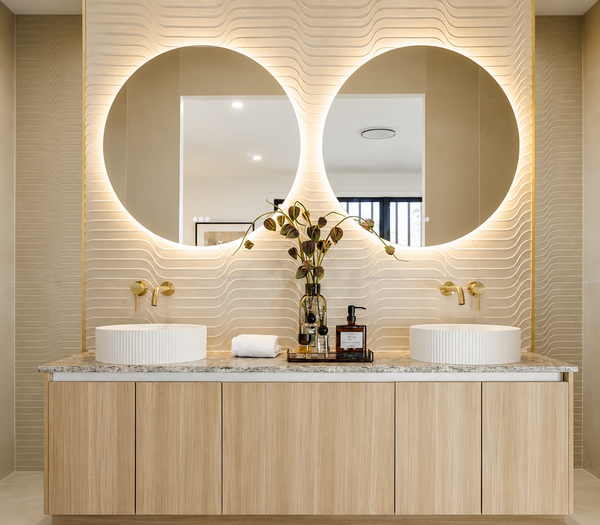
A round mirror at the right width can look slightly short over a long benchtop, which is why it suits powder rooms and ensuites best. The Amalfi starts at 600 mm, so it fits vanities from 600 mm wide, where it fills the full width. It goes up to Ø1200 for a 1200 mm vanity.

Oval and arch
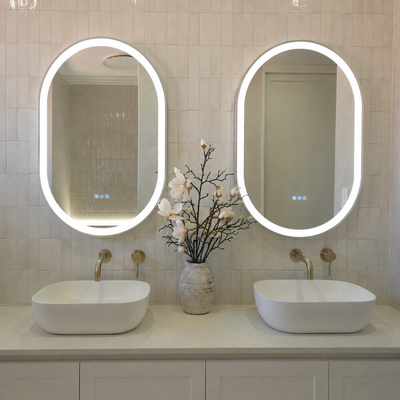
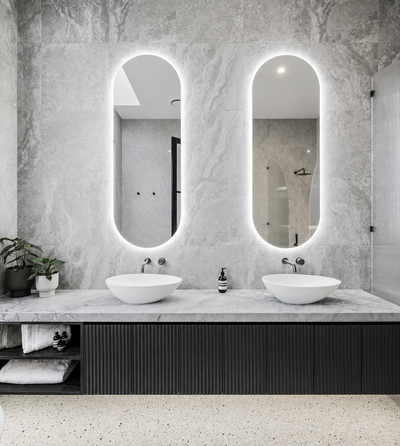
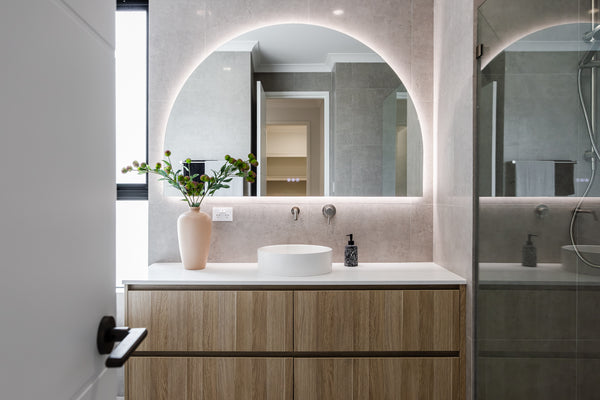
Tall, narrow shapes solve small vanities. The Riviera oval is 450 × 900 mm, so it suits vanities under 600 mm, or a 600 mm vanity one size down, with a full-height reflection. The Positano arch mirror is 600 × 900 mm and fills a 600 mm vanity edge to edge; the Positano Cabinet is a 500 × 900 mm arch with storage.

Rectangle
Rectangles give the most glass for the width. The Florence and Venice start at 900 × 700 mm, so they fit from a 900 mm vanity up, where they fill the full width.

Organic
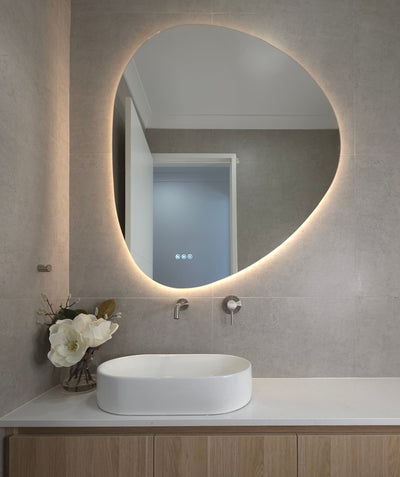
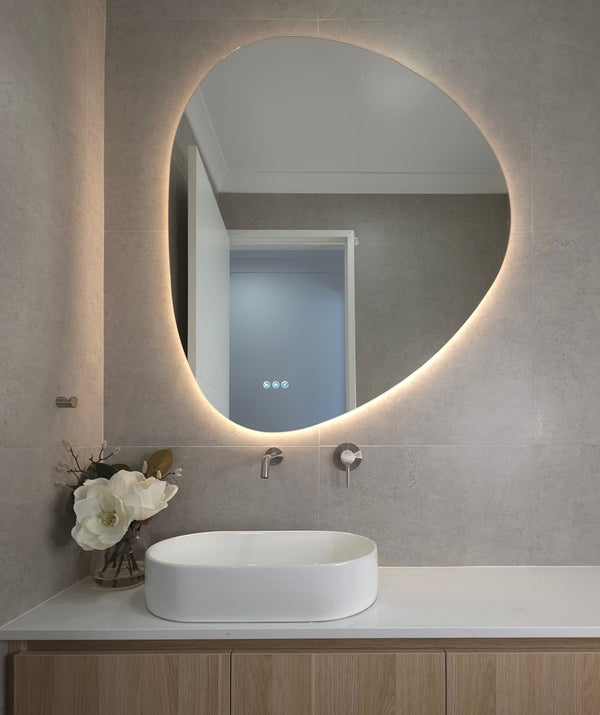
An organic shape like the Lucca carries more visual weight than its width suggests, so it still holds the wall one size down. The Lucca is 760 mm or 940 mm wide. At 760 mm it is wider than a 750 mm vanity, so it starts at the 900 mm row.

Mirror Cabinets: Width, Doors and Depth
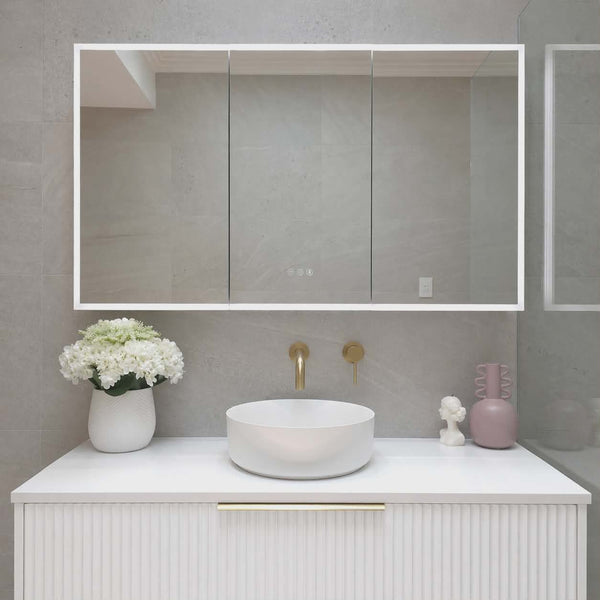
A cabinet follows the same rule, up to the full vanity width and never wider, but it brings two more things to check: how far it projects from the wall, and where the doors swing.
| Cabinet | Sizes (W × H × D, mm) | Doors |
|---|---|---|
| Milan / Madrid | 750, 900, 1200 or 1500 wide × 700 × 117 | Two doors at 750 and 900; three at 1200 and 1500. Outer doors open to 110° |
| Positano Cabinet | 500 × 900 × 118 arch | One door, hinged on the left, opens to 110° |
| Riviera Cabinet | 450 × 1000 or 1150 × 118 oval | One door, hinged on the left, opens to 110° |
| Lucca Cabinet | 760 × 890 × 117 organic | Two doors that open from the middle |
| Santander Cabinet | 1200 × 800 × 117 arch | Doors open from the middle |
| Amalfi Cabinet | Ø800 × 122 round | One opening door, with the electrics on the other side |
Sizes from our live product listings. Our cabinets have soft-close hinges, glass shelves, a mirrored back panel and a 10 A outlet in the top section.
Doors are the reason to think twice about full width. On a 750 mm vanity the 750 mm Milan or Madrid is the best fit, but its outer doors swing past the sides. If the vanity sits between walls, the 500 mm Positano Cabinet is the smaller choice.

For a deeper look at depth, recessing and features, read our mirror cabinet buying guide, or weigh up storage against a plain mirror in mirror cabinet or bathroom mirror. Planning to set it into the wall? Start with recessed vs surface-mounted mirror cabinets.
Height, Once the Width Is Right
Width and height are separate decisions. Our mirror height guide covers height in full, and the bathroom heights and rough-in guide puts every fixture on one drawing. The short version:
- Leave 100–200 mm between the top of the tallest tap or splashback and the bottom of the mirror or cabinet, never less than 100 mm.
- Aim for the centre of the mirror at about 1500–1650 mm above the finished floor.
- Keep the top edge about 100–150 mm below the ceiling or cornice.

What we see go wrong: a mirror raised to clear a tall basin mixer, which then puts the touch buttons and demister above a shorter person’s eye line. If you are pairing a tall mixer with a tall mirror, keep the gap at the lower end, around 150 mm, and let the mirror extend upwards.
Double Vanities: One Wide Mirror or Two?
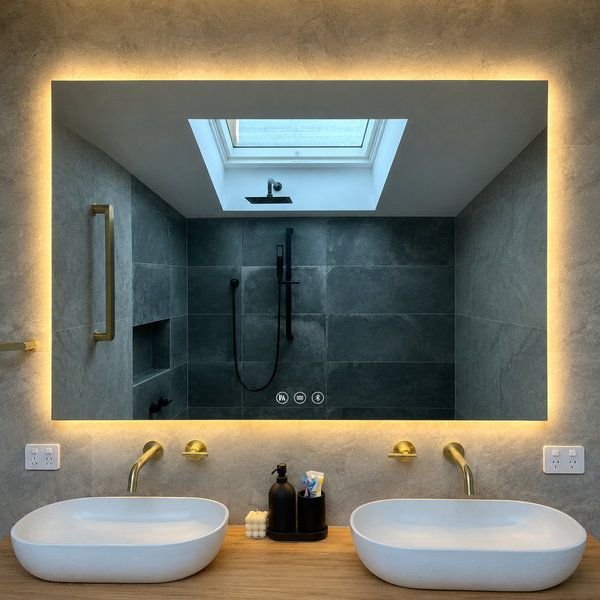
Both work on an 1800 mm vanity. One wide mirror, up to the full 1800 mm, gives a calm, continuous wall and suits a contemporary room: the Venice comes at 1800 × 1000 mm, with the Florence, Venice and Santander at 1500 × 1000 mm one size down. Two mirrors give each person their own space and look best when they are identical and centred over each basin. Two Amalfi rounds at 800 mm are the easy pairing: each goes up to its own half of the vanity, with a sensible gap between them.

If your basins are not centred in each half of the vanity, centre each mirror on its own tap, not on half the benchtop. The fit check’s tap centres field handles this. Our double vanity mirror guide goes through spacing and lighting in more depth.
Common Mirror Sizing Mistakes
- Choosing a small mirror to be safe. A mirror much narrower than the vanity floats on the wall. Go as wide as the vanity allows, or one size down if you'd like a little wall showing either side.
- Going wider than the vanity. It happens most where the size steps are big: a 700 mm round on a 600 mm powder-room vanity hangs past the benchtop. Stop at the vanity width.
- Forgetting the doors. A cabinet that fits the width can still hit a side wall or shower screen when the door opens. Use Open the doors before you order.
- Tiling before choosing the mirror. If tiles are cut around an old mirror, a taller cabinet or mirror may not fit the space left. Choose the size before the tiler sets out.
- Lifting the mirror to clear a tall tap. Keep the 100–200 mm gap from the top of the tap, and choose a taller mirror rather than hanging a short one higher.
Expert Designer Recommendations
| If your bathroom is… | We’d choose | Why |
|---|---|---|
| A powder room with a 600 mm vanity | Riviera 450 × 900 oval | One size down from a 600 mm round, so a little wall shows either side, and the height gives a full reflection on a narrow wall. |
| A 600 mm vanity that needs storage | Positano Cabinet 500 × 900 | The largest cabinet that fits a 600 mm vanity, and an arch. |
| A 900 mm ensuite vanity | Florence or Venice 900 × 700, or a Milan 900 cabinet | Both fill the vanity without passing it. For a little wall either side, the Amalfi Ø800 is one size down. |
| A 1200 mm vanity with a curved bath or basin | Santander at 1200 × 800, the full width of the vanity | The wide arch picks up the curve and fills the vanity without passing it. |
| An 1800 mm double vanity | Two Amalfi Ø800, or one Venice 1800 × 1000 | Two rounds for his-and-hers, one wide rectangle for a calmer wall. |
Frequently Asked Questions
What size mirror for a 900mm vanity?
Go up to 900 mm wide: the Florence or Venice at 900 × 700 mm fills the vanity without passing it, and for storage a Milan or Madrid cabinet at 900 mm does the same. If you'd like a little wall showing either side, choose one size down: the Amalfi round at 800 mm, the Lucca at 760 mm or a 750 mm cabinet.
What size mirror for a 1200mm vanity?
Go up to 1200 mm wide: the Florence, Venice or Santander at 1200 × 800 mm, or the Amalfi round at 1200 mm. For storage, a Milan, Madrid or Santander cabinet at 1200 mm. If you'd like a little wall showing either side, choose one size down: the Amalfi at 1000 mm, the Lucca at 940 mm, or a 900 mm rectangle or cabinet.
What size mirror for a 600mm vanity?
Go up to 600 mm wide: the Amalfi round at 600 mm, the Positano arch at 600 × 900 mm or the Riviera at 600 × 1000 mm all fill the vanity without passing it. For storage, the Positano arch cabinet at 500 × 900 mm is the largest that fits. If you'd like a little wall showing either side, choose one size down: the Riviera oval at 450 × 900 mm, or the 450 mm Riviera Cabinet.
Can a bathroom mirror be the same width as the vanity?
Yes, and it's what we recommend: go as wide as your vanity allows, up to its full width but never wider. Our fit check marks the largest size that fits as the Best fit. If you'd like a little wall showing either side, choose one size down. Never go wider than the vanity, for any shape.
What size mirror for an 1800mm double vanity?
You have two good options. One wide mirror up to the full width, such as the Venice at 1800 × 1000 mm, or the Florence, Venice or Santander at 1500 × 1000 mm one size down. Or one mirror over each basin, each up to its own half: two Amalfi rounds at 800 mm, which the fit check shows with about 100 mm between them when each basin sits in the middle of its half.
Do mirror cabinets follow the same width rule?
Yes. Our fit check uses the same rule for mirrors and cabinets: up to the full vanity width, never wider. A cabinet also has doors, so check what sits beside the vanity before you buy. Our cabinets are 117–122 mm deep, and on cabinet pages the fit check has an Open the doors button that shows the doors swinging out over your vanity.
Designer’s Cheat Sheet
Designer’s Cheat Sheet
- ✔ Width → up to the full vanity width, never wider; one size down for a little wall either side
- ✔ 600 mm vanity → a 600 mm round or arch (oval one size down)
- ✔ 900 mm vanity → a 900 mm rectangle or cabinet
- ✔ 1200 mm vanity → a 1200 mm rectangle, arch, round or cabinet
- ✔ Gap above the tap or splashback → 100–200 mm, never under 100 mm
- ✔ Cabinet → check the doors open clear of walls and screens
- ✔ Not sure → type your width into Check it fits your vanity
Conclusion
Measure the top of the vanity, then go as wide as it allows, never wider. If you'd like a little wall showing either side, choose one size down. That one check rules out most of the mistakes we see, and the chart above turns it into real sizes. When you are on a product page, the fit check does the same sum for you and draws it to scale, doors included.
If you are planning a small room, our small bathroom mirror guide picks up from here with the narrowest options and cabinet depths.
Where To Next?
- Hanging it: How High Should You Hang a Bathroom Mirror?
- Choosing a shape: Round vs Arch vs Rectangle Bathroom Mirrors
- Small rooms: Best Bathroom Mirrors for Small Bathrooms
- Storage: The Ultimate Mirror Cabinet Buying Guide
- Swapping out an old mirror: How to Replace a Bathroom Mirror with an LED Mirror
- Shop by shape: Round, Arch, Rectangle and Oval & Irregular mirrors, or the full Mirror Cabinets range
Need help? Ask us with a photo.
Send us a photo of your vanity and wall, or your plans, and we’ll tell you which sizes fit, or call 1300 221 495.

