


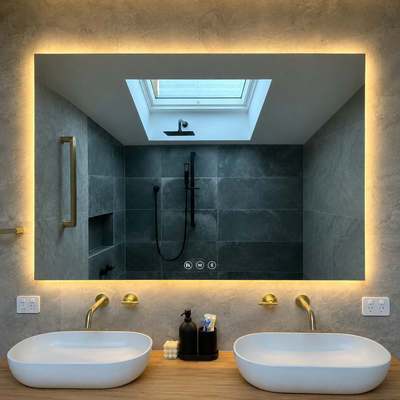
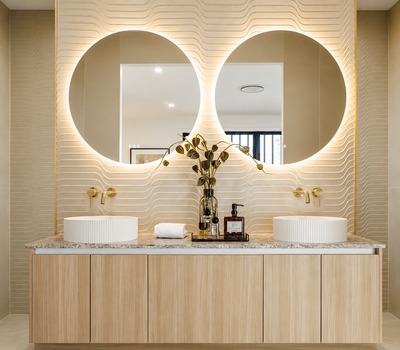
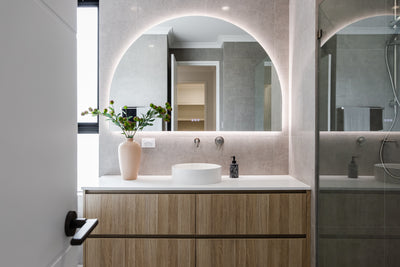
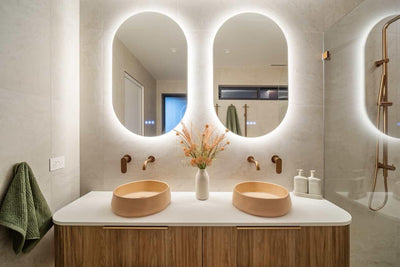
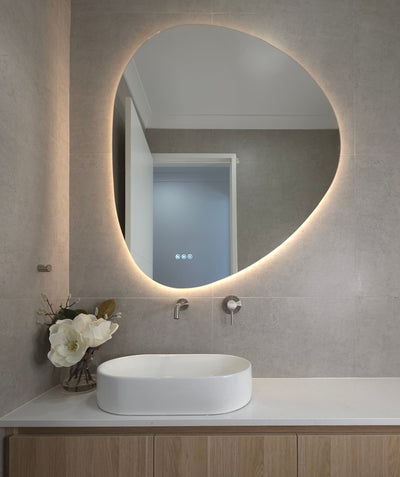
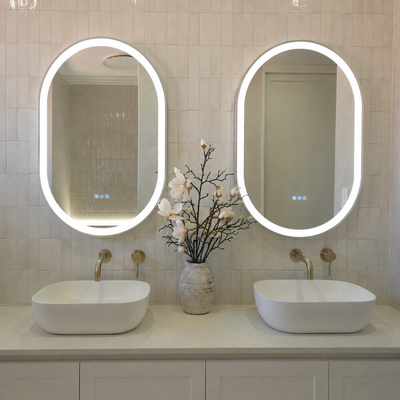
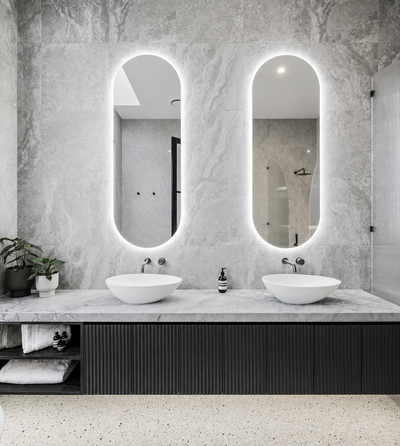


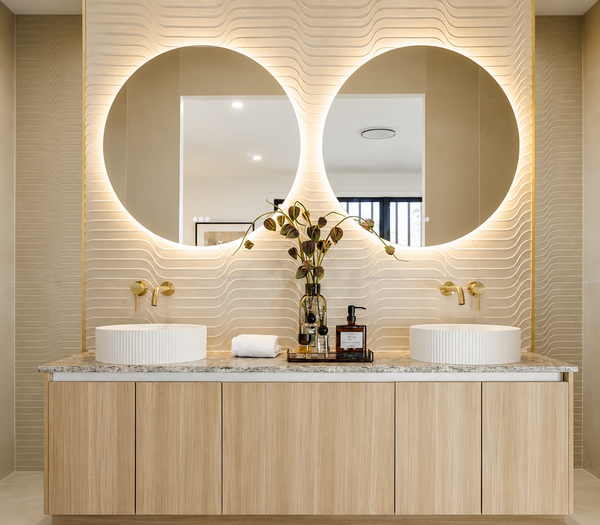
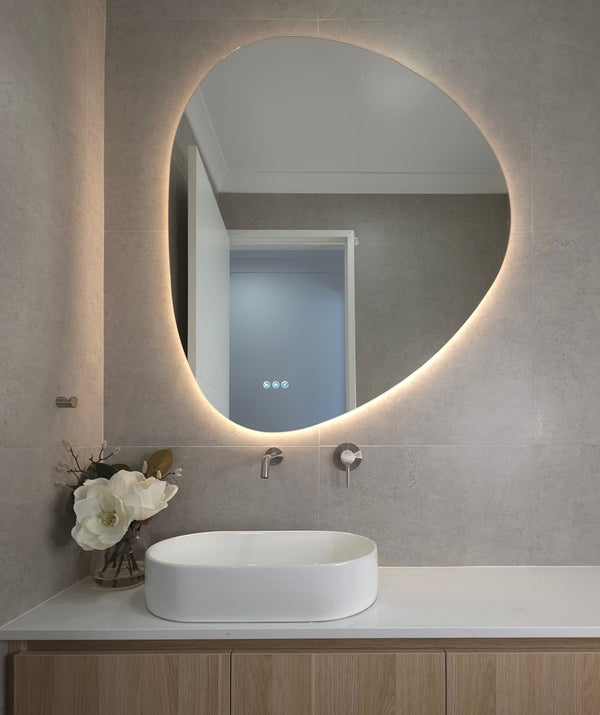
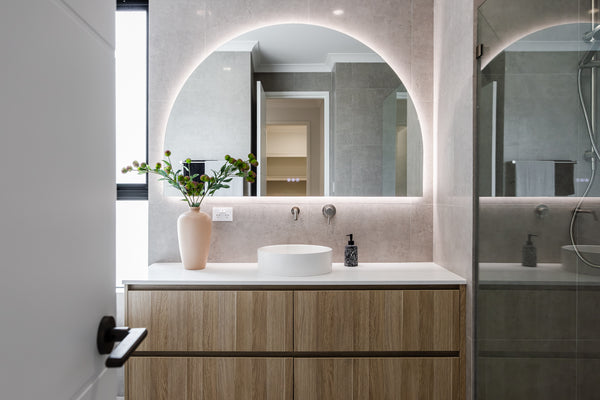
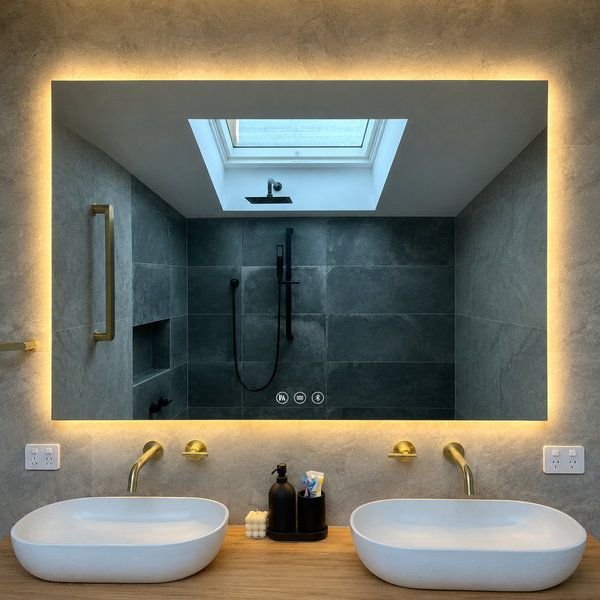
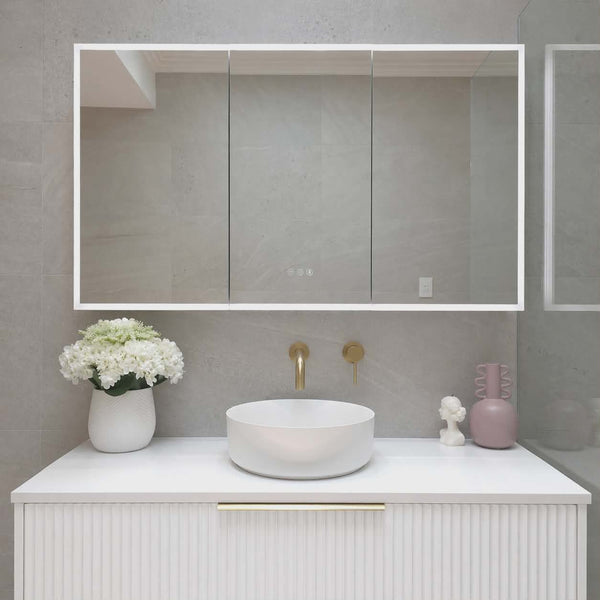

A mirror cabinet is a bathroom mirror with storage, lighting and power built in behind it. Get the width, height and door swing right and it does more work than any other fixture on the wall. Get one of them wrong and you'll notice every morning: doors that hit the side wall, a cabinet you bump your head on, or a box that looks too small over the vanity.
This guide covers the decisions in the order you make them: surface-mounted or recessed, what size for your vanity, how high to hang it over the tap, how the doors open, and which features are worth having. Every number comes from our own cabinets, so you can match it to a real model.
Updated 13 October 2026. Sizes and features read from our product pages and factory drawings on that date.
Why Trust InVogue Mirrors & Bathware? InVogue is an Australian retailer trusted in over 20,000 homes, specialising in LED bathroom mirrors and mirror cabinets. The guidance in this article reflects genuine day-to-day usability considerations, not just feature lists.
Quick Answer
Choose the widest cabinet your vanity allows, never wider, and hang it 100–200 mm above the top of the tap or splashback. Then check the doors have room to open and that the power is planned before tiling.
- 900 mm vanity: a 900 mm Milan or Madrid. 1200 mm vanity: a 1200 (Milan, Madrid or Santander). 1500 mm vanity: a 1500. Choose one size down if you'd like a little wall showing either side.
- Hang it so the centre sits about 1500–1650 mm from the floor, with at least 100 mm above the tap.
- Ours are 117 mm deep (118 mm Riviera and Positano, 122 mm Amalfi), so surface mounting works in most bathrooms. The Amalfi Cabinet is surface-mount only.
- Milan and Madrid doors open to 110°, so leave room beside a side wall. Santander and Lucca doors open from the middle.
- Every model has an IP-rated 10 A outlet inside and is hardwired by a licensed electrician.
What Is a Mirror Cabinet?
It's a shallow wall cabinet whose doors are mirrors. Open the doors and you get shelves; close them and you have the room's main mirror. An LED mirror cabinet adds face lighting, a demister and a power outlet inside, and it's hardwired like an LED mirror.
Ours are frameless, with a mirrored back panel inside (the side walls aren't mirrored), adjustable glass shelves and soft-close hinges. They come in rectangles, arches, a pill shape, an organic pebble shape and a circle, so the cabinet can match the shape of mirror you would otherwise have chosen.

Why Choose a Mirror Cabinet?
Choose one when your benchtop is losing the battle with toiletries. A cabinet gives you storage at eye level without using floor space, and the power point inside means the toothbrush and shaver charge out of sight instead of trailing a cord across the splashback.
It isn't always the right answer. If the wall between the tap and the cornice is short, a cabinet can end up too close to a tall mixer. If you have a deep vanity and a linen cupboard, a plain LED mirror may be all you need. Our mirror cabinet or bathroom mirror guide walks through that choice.
Designer Insight: the households that get the most from a cabinet are the ones sharing one bathroom in the morning. Give each person a shelf and the benchtop stays clear.
Recessed vs Surface-Mounted Mirror Cabinets
Surface-mount if your walls are already tiled; recess if the frame is open and the wall is deep enough. Recessed, the 98 mm body of our cabinets goes into the wall and only about 19–20 mm of door stays proud. The one exception is the round Amalfi Cabinet, which is surface-mount only and can't be recessed. Surface-mounted, they stand 117–122 mm off the wall, which is slimmer than many cabinets on the market. Recessing needs a framed opening and the cable placed before lining, so it's decided at framing stage.
| Install type | Stands off the wall | Best for |
|---|---|---|
| Surface-mounted | 117–122 mm | Existing bathrooms, finished walls, quick upgrades |
| Recessed | About 19–20 mm | Renovations with the frame open and a clear, deep enough wall |
| Semi-recessed | In between | Shallow walls; talk to us and your builder first |
Wall depth, stud spacing and the cut-out rule are covered in detail in recessed vs surface-mounted mirror cabinets.
Choosing the Right Size
Go as wide as your vanity allows, up to its full width but never wider. If you'd like a little wall showing either side, choose one size down. That's the rule behind the "Check it fits your vanity" tool on every cabinet page: type your benchtop width and it marks the largest size that fits as the best fit and flags any size that's too wide. The table below runs the same rule over every cabinet size we sell.
Swipe the table sideways to see every column →
| Vanity width | Best fit (largest that fits) | One size down |
|---|---|---|
| 600 mm | Positano 500 × 900 | Riviera 450 × 1000 or 1150 |
| 750 mm | Milan or Madrid 750 × 700 | Positano 500 × 900 |
| 900 mm | Milan or Madrid 900 × 700 | Amalfi Cabinet Ø800, Lucca 760 × 890, Milan or Madrid 750 × 700 |
| 1200 mm | Milan, Madrid or Santander 1200 | Milan or Madrid 900 × 700 |
| 1500 mm | Milan or Madrid 1500 × 700 | Milan, Madrid or Santander 1200 |
| 1800 mm | Milan or Madrid 1500 × 700 | Milan, Madrid or Santander 1200 |
A few things the table can't tell you:
- Height matters as much as width. The Milan and Madrid are 700 mm tall, the Santander 800, the Lucca 890, the Positano 900 and the Riviera 1000 or 1150. On a short wall above a tall mixer, a 700 mm cabinet is easier to fit.
- Odd vanity widths: work it out. Take the largest size that doesn't pass the vanity: a 1050 mm vanity takes the 900 mm Milan or Madrid, or the 800 mm Amalfi Cabinet one size down.
- Two basins: one wide cabinet, or two narrow ones centred over each basin. Two Rivieras over a double vanity work well.

For mirror widths and the reasoning behind the rule, see how to choose the right mirror size for your vanity.
How High Should a Mirror Cabinet Hang?
Leave 100–200 mm between the top of the tap or splashback and the underside of the cabinet, never less than 100 mm, and aim for the centre to sit about 1500–1650 mm from the floor. These are the same figures as for a mirror; a cabinet just makes mistakes more obvious because it projects from the wall.
Measure from the highest thing on the vanity. For a typical 850 mm benchtop with a 175 mm Vienna Short mixer, the tap top is at 1025 mm, so a 200 mm gap puts a 700 mm cabinet's underside at 1225 mm and its centre at 1575 mm. Swap in a 305 mm Vienna Tall and everything moves up by 130 mm.

The mirror height guide has the full chart by vanity and tap height and our bathroom heights and rough-in guide puts every fixture on one drawing.
How the Doors Open (and How Much Room They Need)
Check which way the doors swing before you choose a size, because the hinge side is fixed. Our cabinets use three door layouts, and each needs a different amount of room.

Milan and Madrid: hinged at the outer edges, open to 110°
The 750 and 900 sizes have two doors, hinged on the left and right edges. The 1200 and 1500 sizes have three: the left door hinges on its left edge, the middle door on the internal divider, and the right door on its right edge. Every door opens to 110°, so the outer doors swing past the side of the cabinet. That's the one to watch next to a side wall, a shower screen or a second cabinet.
Swipe the table sideways to see every column →
| Size | Doors (width each) | Side-wall room per outer door (about) |
|---|---|---|
| Milan / Madrid 750 | 2 × 374 mm | 130 mm |
| Milan / Madrid 900 | 2 × 449 mm | 155 mm |
| Milan / Madrid 1200 | 3 × 399 mm | 135 mm |
| Milan / Madrid 1500 | 3 × 499 mm | 170 mm |
| Positano 500 (one door) | 1 × 500 mm | 170 mm on the hinge side |
| Riviera 450 (one door) | 1 × 450 mm | 155 mm on the hinge side |
Santander and Lucca: doors open from the middle
On the Santander and the Lucca, the doors hinge on internal dividers rather than the outside edges, so they open from the middle and stay within the cabinet's width. They open to about 90°. Two doors that share a divider can't both be pushed past that at once, so open one at a time when you want full access. The upside is that neither needs room beside a side wall.

Amalfi Cabinet: one opening door
The round Amalfi Cabinet has one door that opens, and it's surface-mount only. The other side is fixed and holds the electrics, with the outlet up at the top, to the right of the opening door. Because the opening angle isn't published yet, check it on site if the cabinet sits close to a wall.
Designer Insight: if you're hanging two cabinets side by side over a double vanity, the doors that meet in the middle can clash. Leave a gap between them, or choose one 1500 mm cabinet instead.
Essential Features to Look For
Prioritise the features you'll use every day: light, a demister, power inside and shelves you can move. Everything else is a bonus. Here's what each one does on our cabinets.
| Feature | What it does for you |
|---|---|
| Demister | A heated pad behind the mirror keeps it clear after a shower. On our cabinets it switches itself off after an hour. |
| Adjustable LED light | Three colour modes from warm 2700 K to cool 6500 K (2700–6400 K on the Amalfi Cabinet), and dimmable. Warm for the evening, cool for make-up and shaving. |
| Power inside | An IP-rated 10 A outlet in the top section. The toothbrush and shaver charge behind the door, not on the benchtop. |
| Adjustable glass shelves | Set the shelf heights around what you store, so a tall bottle doesn't force a whole shelf to waste. |
| Sensor light inside | An LED in the top of the cabinet comes on when you open the door, which helps when the room lights are low. |
| Bluetooth speakers | Built in, for music or a podcast while you get ready. |
| Magnifier | A small magnifying mirror on the inside of a door on the Milan, Madrid and Santander. |
| Soft-close hinges | Doors close quietly and the hinges adjust three ways, so doors can be lined up after installation. |
| Copper-free mirror glass | Better at resisting the black edges that cheap mirrors develop in humid bathrooms. |

Designer Insight: the outlet sits in the top section, so before you choose a size, look at the interior photos on the product page and picture your tallest bottles on the shelves below it.
Our Mirror Cabinets Compared
All seven share the same essentials; they differ in shape, size, door layout and the magnifier. Use this to narrow down before you open the product pages.
Swipe the table sideways to see every column →
| Cabinet | Shape and sizes (W × H) | Depth | Doors | How they open | Magnifier |
|---|---|---|---|---|---|
| Milan | Rectangle: 750, 900, 1200, 1500 × 700 | 117 mm | 2 (750, 900) or 3 (1200, 1500) | Outer edges and divider, 110° | Yes, left door (3×) |
| Madrid | Rectangle: 750, 900, 1200, 1500 × 700 | 117 mm | 2 (750, 900) or 3 (1200, 1500) | Outer edges and divider, 110° | Yes: left door (750, 900); middle door (1200, 1500) |
| Santander | Wide arch: 1200 × 800 | 117 mm | 3, about 400 mm each | From the middle, about 90° | Yes, middle door |
| Lucca | Organic pebble: 760 × 890 | 117 mm | 2, about 380 mm each | From the middle, about 90° | Not listed |
| Positano | Tall arch: 500 × 900 | 118 mm | 1 (the whole arch) | Hinged on the left, 110° | No |
| Riviera | Pill: 450 × 1000 or 1150 | 118 mm | 1 (the whole pill) | Hinged on the left, 110° | No |
| Amalfi Cabinet | Round: Ø800 | 122 mm (surface-mount only) | 1 opening door; the other side is fixed | One door | No |


Mirror Cabinets for Different Bathroom Types
Small bathrooms and ensuites
Go narrow and tall rather than wide. A Riviera (450 mm) or Positano (500 mm) suits a 600 mm vanity, and their single doors need room on one side only. If the wall is tight beside a shower screen, check the hinge side first.
Family bathrooms
Width wins. A 1500 Milan or Madrid over a 1500 or 1800 vanity gives each person a section, and the three-door layout means you can open one door without blocking the basin.

Apartments and rentals
Surface-mounted, every time. There's no wall work beyond the bracket and the cable, and at 117 mm deep the cabinet doesn't crowd the basin.
Statement ensuites and powder rooms
This is where shape earns its place: the Santander's wide arch, the Lucca's pebble outline or the round Amalfi Cabinet. In a powder room with little to store, ask whether a plain LED mirror would do the job just as well.

Styling Mirror Cabinets
Match the cabinet's shape to the room, and its light to the room's other lights. A frameless cabinet reads as a mirror first, so pick the shape you would have chosen for a mirror: arches and pebbles soften a room of straight lines, rectangles suit a modern or double vanity. Then set the colour temperature to sit with your ceiling lights rather than against them. Tapware is the other thing your eye lands on, and our tapware finishes guide helps you choose one finish for the whole room.
Common Buying Mistakes
- Choosing a cabinet wider than the vanity. It always looks top-heavy. Go up to the vanity width, never past it.
- Measuring the gap from the benchtop. Measure from the top of the tap or splashback; a tall mixer changes everything.
- Ignoring the hinge side. Outer-hinged doors need room beside a side wall or shower screen, and the hinge side can't be swapped.
- Leaving the power until last. The cable has to come out behind the cabinet body, so plan it before tiling.
- Deciding to recess after the tiles are up. Recessing is a framing-stage decision. After tiling, surface-mount.
- Buying for shelf count, not shelf height. Adjustable glass shelves matter more than the number of them.
Expert Designer Recommendations
- 900 mm vanity, single basin: a Milan or Madrid 750, or the Lucca if you want a softer shape.
- 1200 mm vanity: a Milan or Madrid 900, or the Santander at 1200 for a full-width arch.
- 1500–1800 mm double vanity: a 1200 or 1500 Milan or Madrid, or two Rivieras, one per basin.
- Tight wall beside a shower: the Santander or Lucca, whose doors open within the cabinet's width.
- Renovating with the frame open: plan a recess and buy the cabinet before framing.
Frequently Asked Questions
What size mirror cabinet do I need for a 900 mm vanity?
Go as wide as the vanity allows: a 900 mm Milan or Madrid fills a 900 mm vanity without passing it. If you'd like a little wall showing either side, or the outer doors need more room, choose one size down: the Amalfi Cabinet at 800 mm, the Lucca at 760 or a Milan or Madrid 750. Never go wider than the vanity.
How high should a shaving cabinet be above the vanity?
Measure from the top of the tap or splashback, not the benchtop. Leave 100–200 mm from there to the underside of the cabinet, never less than 100 mm, and aim for the cabinet's centre to land about 1500–1650 mm from the floor. On an 850 mm vanity with a 175 mm mixer, a 200 mm gap puts the underside at 1225 mm.
How deep is a mirror cabinet?
Ours are 117 mm deep, apart from the Riviera and Positano at 118 mm and the Amalfi Cabinet at 122 mm. Many LED cabinets we compared from other sellers are 130–160 mm deep. If you recess ours, only about 19–20 mm of door stays in front of the wall. The Amalfi Cabinet is the exception: it's surface-mount only.
Do mirror cabinets have a power point inside?
Ours do. Every model has an IP-rated 10 A outlet in the top section, so a toothbrush or shaver can charge behind the door. The cabinet itself is hardwired, so a licensed electrician connects it and confirms the bathroom zone and RCD protection.
Which way do the mirror cabinet doors open?
On the Milan and Madrid, the outer doors are hinged on the outside edges and open to 110°; on the 1200 and 1500 sizes the middle door hinges on the internal divider. Santander and Lucca doors open from the middle. The Amalfi Cabinet has one opening door. The hinge side is fixed, so check it against your side wall before ordering.
How much room do mirror cabinet doors need from a side wall?
For a door hinged on the outside edge to open fully to 110°, allow roughly 130–170 mm plus about 20 mm for the hinge and door thickness, depending on the door width. Doors hinged on an internal divider, like the Santander and Lucca, stay within the cabinet's width.
Are mirror cabinets worth it?
If you're short of storage and your basin wall has room, yes. A cabinet takes the toiletries off the benchtop, adds face lighting and a demister, and gives you a hidden power point. If you only need a mirror, or the space above the tap is tight, a plain LED mirror is simpler and cheaper.
Designer's Cheat Sheet
Designer's Cheat Sheet
- ✔ Width? → up to the full vanity width, never wider
- ✔ Height? → 100–200 mm above the tap, centre about 1500–1650 mm
- ✔ Side wall close? → Santander or Lucca, or allow about 130–170 mm plus 20 mm
- ✔ Tiles already up? → Surface-mount; ours stand 117–122 mm off the wall
- ✔ Frame open? → Recess, and buy the cabinet before framing
- ✔ Power? → Hardwired, cable behind the body, planned before tiling
Conclusion
Most cabinet regrets come from the wall, not the cabinet: a hinge side that fights a shower screen, a tap that's taller than planned, a cable left where the old mirror was. Measure those three things and the choice gets easy. Start with the width rule, use "Check it fits your vanity" on the product page to see how each size sits over your benchtop, and compare the full mirror cabinet range.
Where To Next?
- Installing: Recessed vs Surface-Mounted Mirror Cabinets and Replacing a Builder's Mirror with an LED Mirror or Cabinet
- Still deciding: Mirror Cabinet or Bathroom Mirror? and Double Vanity Mirror Guide
- Features in depth: LED Mirror Features Explained and Do LED Mirrors Need an Electrician?
- More storage ideas: Bathroom Storage Ideas
- Browse: the full Mirror Cabinets range
Need help? Ask us with a photo.
Send a photo of your basin, wall or plans and we will tell you what fits or call 1300 221 495.

